
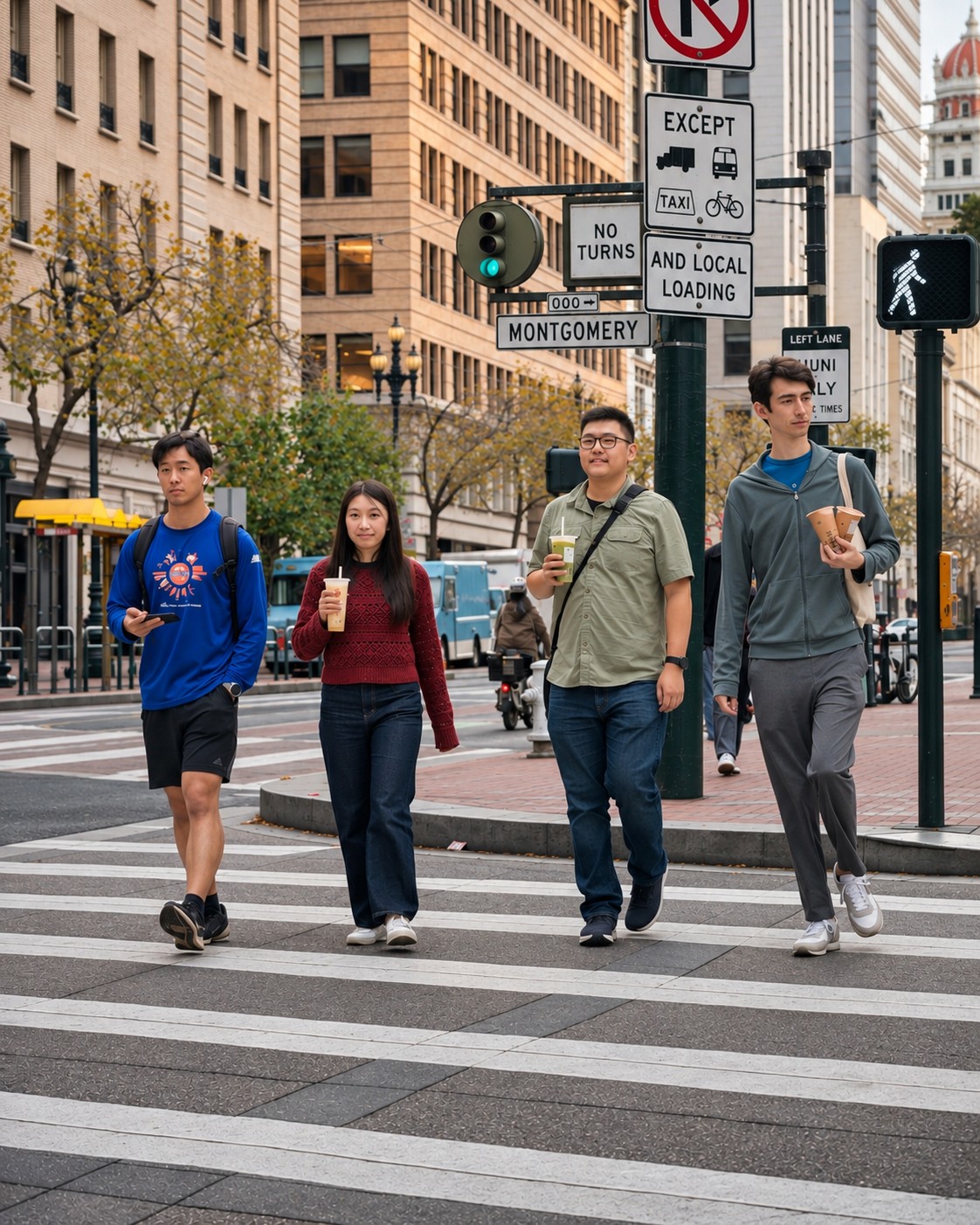
In San Francisco, most people killed in traffic are not in a car. They are on foot.
In 2024, 43 people died in traffic on city streets. Twenty-four of them were pedestrians, the highest number since 2007. Total deaths fell to 25 in 2025. Through September of this year the city has counted 19, and 13 of them were people walking.
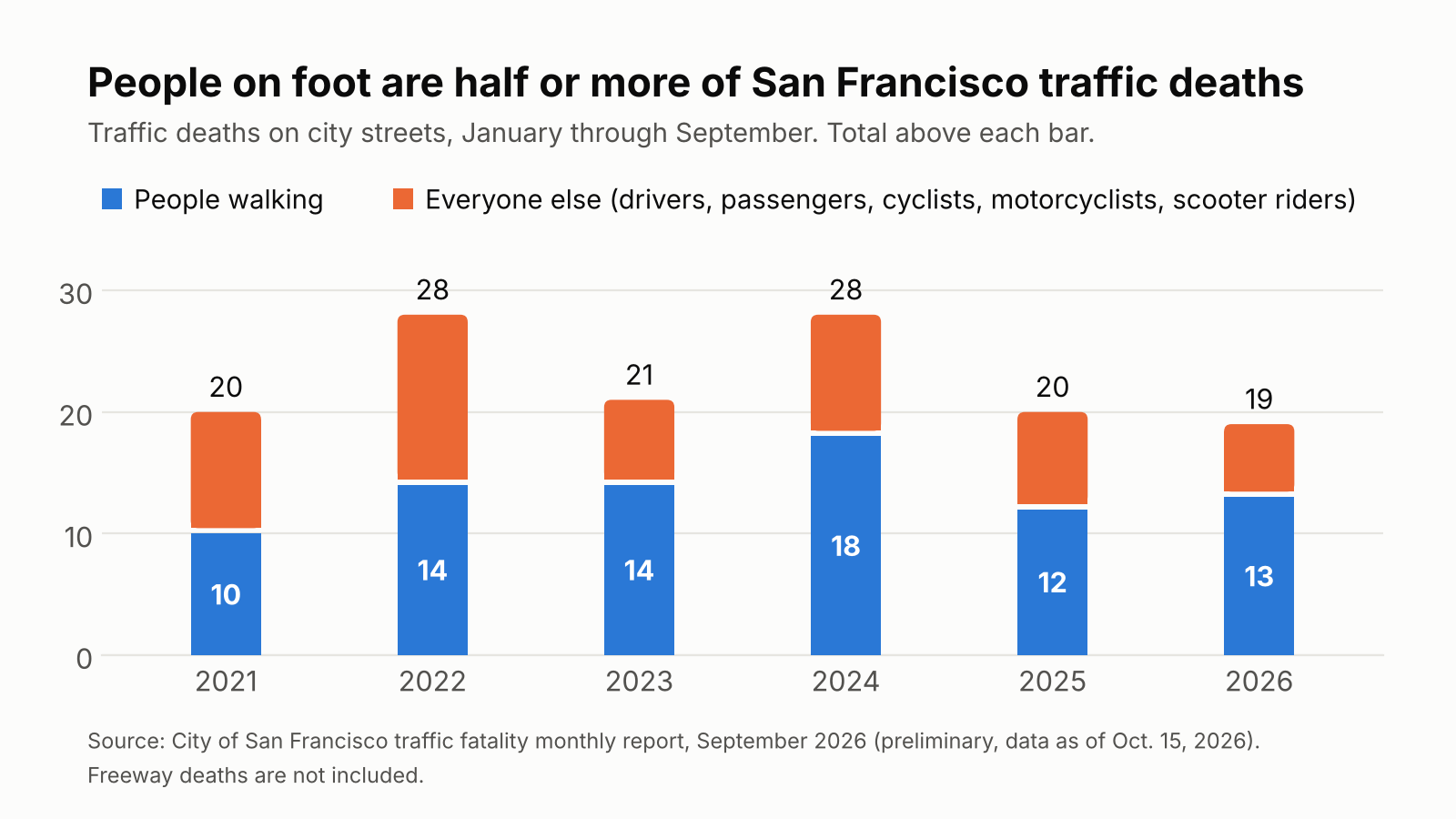
Across the United States, pedestrians were 18% of traffic deaths in 2024. In San Francisco they were 56%.

I am an injury attorney in San Francisco. I have represented people hit in crosswalks and the families of people killed in them. This article covers what the numbers show, what the law requires of drivers at a crosswalk, the rules that are specific to San Francisco, and what a family should do after a death.
Most pedestrian accidents here happen at a crosswalk
The city’s traffic engineer reviewed 3,073 accidents that injured or killed a pedestrian from 2020 through 2024. In 38% of them, the main violation police recorded was a driver who did not yield at a crosswalk. The next most common, a pedestrian who did not yield outside a crosswalk, was 11%.

The same report says more than 70% of injury accidents in San Francisco happen at intersections. The national picture is different. Across the country, about three of four pedestrian deaths happen away from an intersection.
Deaths are harder to sort. The city does not publish how many pedestrians were killed inside a crosswalk. In its report on 2024, police put the fault on the driver in 7 of the 24 pedestrian deaths and on the pedestrian in 13. In a death case the pedestrian cannot give their side. A police report is one piece of evidence. It does not decide a civil claim.
Why these accidents are so often fatal
- Speed. A pedestrian struck at 30 mph is up to eight times as likely to die as one struck at 20 mph, according to the San Francisco Civil Grand Jury’s 2025 report on street safety. Unsafe speed was the leading cause police recorded in the city’s 2024 traffic deaths, in 11 of 43.
- Age. Seven of the 24 pedestrians killed in 2024 were 65 or older. In 2025, 12 of the 16 were seniors, according to Walk San Francisco.
- Darkness. In 2024, 44% of the city’s traffic deaths happened between 10 pm and 6 am.
- A person against a car. In San Francisco accidents between a vehicle and a pedestrian, 23 of every 1,000 injuries were fatal from 2014 to 2024. In accidents involving only vehicles, it was 4.
- Drivers who leave. About one in five injury accidents in the city is a hit-and-run. In 2024 there were 602.
What California law requires at a crosswalk
- Drivers must yield. A driver must yield to a pedestrian crossing in any marked crosswalk, and in any unmarked crosswalk at an intersection (Vehicle Code 21950(a)).
- A corner is a crosswalk even without paint. The law treats the path between the sidewalks at an intersection as a crosswalk unless a sign prohibits crossing (Vehicle Code 275). This matters on residential streets where the corners have no painted lines.
- Drivers must slow down. A driver approaching a pedestrian in a crosswalk must use all due care, and must slow down or do whatever else is needed to keep the pedestrian safe (Vehicle Code 21950(c)).
- No passing a stopped car. A driver may not pass a car that has stopped at a crosswalk to let someone cross (Vehicle Code 21951).
- Pedestrians have duties too. A person may not step off the curb into the path of a car that is close enough to be an immediate hazard (Vehicle Code 21950(b)). That does not excuse the driver from using due care (Vehicle Code 21950(d)).
- Outside a crosswalk. The pedestrian must yield to cars that are an immediate hazard, and the driver must still use due care (Vehicle Code 21954).

San Francisco’s own crosswalk rules
- How to cross. The San Francisco Transportation Code requires a pedestrian to cross straight across the street, by the shortest route to the opposite curb. In the Downtown Core, a pedestrian must cross in a crosswalk (Section 7.2.10).
- No parking near a crosswalk. State law bars parking within 20 feet of the approach to any crosswalk, painted or not, so drivers and pedestrians can see each other (Vehicle Code 22500(n)). Under the plan the city announced in 2025, San Francisco tickets only where the curb is painted red, and it plans to paint every corner by summer 2027.
- Speed cameras. San Francisco has speed cameras at 33 locations. Since August 5, 2025, a driver going 11 mph or more over the limit can be ticketed, with fines from $50 to $500.
- Lower speed limits. The city has lowered the limit by 5 mph on 79 business corridors and 38 high-injury corridors. Schools have 15 mph zones. The Tenderloin has a 20 mph limit.
- No turn on red. Turns on red are banned in the Tenderloin, and the city has approved the same ban at about 200 downtown intersections.
These rules matter in a claim. A violation of one of them can be evidence that the driver was negligent.
A case from my practice
I represented a man whose 84-year-old mother was struck and killed in a crosswalk in the Richmond District. It was just after dark. The driver was going straight on a 25 mph street with no stop sign for him at that corner. He told police he braked but could not stop in time. Police concluded that he had failed to yield to her in the crosswalk.
The driver’s insurance paid its limit of $100,000. Another $400,000 came from her own auto policy, under its underinsured motorist coverage, even though she was on foot when she was hit. The total was $500,000.
Two things in that case are common. Fault can be clear and the driver’s insurance can still be too small. And a family may have coverage it does not know about.
Each result depended on the facts of that case. Results will differ if based on different facts. Past results do not guarantee a similar result in your case.
If a family member was killed in a crosswalk
- Get the police report. In San Francisco, a fatal accident is investigated by the police department’s Traffic Collision Investigation Unit, (415) 553-1245. Ask for the report number. To request a copy, follow the steps in How to Get Your San Francisco Accident Report. You can request it online through SFPD’s request form, in person at SFPD Headquarters, 1245 3rd Street, or by mailing form SFPD 491E to the Report Management Section, 1245 3rd Street, San Francisco, CA 94158. Do not email the request. Use sfpd.cisu.reports@sfgov.org only to follow up on a request you have already made. The department asks you to allow 10 business days. Call (415) 575-7232 to check that the copy is ready. The full report in a death case can take several weeks.
- Find the insurance. Ask for the driver’s policy limits. California’s minimum is $30,000 for one person’s injury or death, so the driver’s policy is often not enough. Then check every auto policy in the household for uninsured or underinsured motorist coverage. It can apply to a person who was walking.
- If the driver left the scene. Call the San Francisco Police Department at (415) 553-0123, or 911 if anyone is hurt or in danger. Then tell your own insurance company. Uninsured motorist coverage can apply to a hit-and-run, and policies set short deadlines for reporting one.
- Wait on the recorded statement. Do not give a recorded statement to the driver’s insurance company before you talk to an injury attorney.
- Save the evidence early. Camera footage from homes, businesses and buses may be kept for only a short time. Witnesses are harder to find later.
- Know who can bring the claim. A wrongful death claim belongs to the surviving spouse or domestic partner and the children. If there are none, it belongs to the people who would inherit under state law (Code of Civil Procedure 377.60).
- Know the deadlines. The deadline to file a wrongful death lawsuit is two years (Code of Civil Procedure 335.1). If a city vehicle, a Muni bus or the design of a street is involved, a written claim must be given to the government within six months (Government Code 911.2).
San Francisco police numbers
- SFPD non-emergency: (415) 553-0123
- Traffic Collision Investigation: (415) 553-1245
- Police reports (Records): (415) 575-7232
- Emergencies: 911
Talk to an injury attorney
I live in San Francisco and my office is here, at 1388 Sutter Street, Suite 810. Some of the injury firms on billboards around the city are based in other cities.
Wakeford Law Firm represents people hurt in pedestrian accidents, and the families of people killed in them, in the Richmond, the Sunset, the Mission, SoMa, the Tenderloin and across San Francisco. Call (415) 578-3510 for a free case review with an injury attorney.
This article is general information. It is not legal advice.
The people in the photographs are not clients and have no connection to any case.
Sources
- SFMTA, 2023-2024 San Francisco Traffic Crashes Report (Aug. 20, 2025)
- San Francisco Department of Public Health, Vision Zero Traffic Fatalities: 2024 End of Year Report (July 2025)
- City of San Francisco, traffic fatality monthly report, September 2026
- SFMTA, San Francisco Traffic Fatalities Drop by Nearly Half in 2025 (Jan. 8, 2026)
- Governors Highway Safety Association, Pedestrian Traffic Fatalities by State: 2025 Preliminary Data (July 2026)
- San Francisco Civil Grand Jury, Failed Vision: Revamping the Roadmap to Safer Streets (June 17, 2025)
- Walk San Francisco, Traffic deaths in San Francisco fell in 2025 (Jan. 8, 2026)
- California Vehicle Code 21950, 275, 21951, 21954 and 22500
- San Francisco Transportation Code, Section 7.2.10
- SFMTA, daylighting program (Apr. 17, 2025)
- SFMTA, Speed Camera Tickets Start Today (Aug. 5, 2025)
- SFMTA, Speed Management
- SFMTA, No Turn on Red Downtown Expansion Project
- Code of Civil Procedure 377.60 and 335.1; Government Code 911.2
- San Francisco Police Department, Contact and Directory
- San Francisco Police Department, Request for Incident Report for General Crime and Traffic Collisions (form SFPD 491E)