
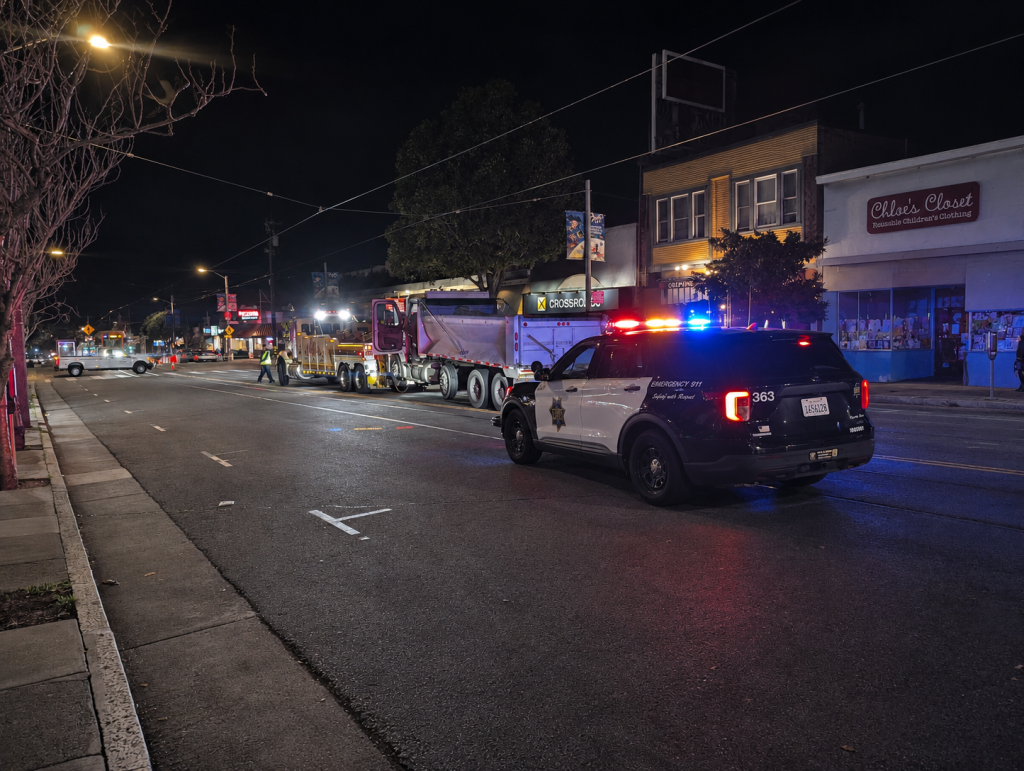
After a car crash, it is important to document what happened. A traffic collision report is one of the most important records you can have. It preserves evidence while the details are still clear, identifies witnesses, and helps prove who was at fault.
California law also requires the driver of any vehicle in a crash that injures or kills someone to make a written report within 24 hours. In San Francisco, the report goes to either the California Highway Patrol (CHP) or the San Francisco Police Department (SFPD).
This guide explains, step by step, how to get a copy of your collision report in San Francisco, using SFPD’s and CHP’s own instructions.
- 1 Which Agency Has Your Report?
- 2 How to Request an SFPD Accident Report
- 3 How to Request a CHP Accident Report
- 4 If There Is No Police Report
- 5 Body Camera Video, Photos and 911 Records
- 6 Your Separate Report to the DMV
- 7 What Is in an Accident Report?
- 8 Who Can Get a Copy?
- 9 How Can a San Francisco Accident Report Help Me?
- 10 Talk to a Lawyer Soon After a Crash
Which Agency Has Your Report?
It depends on where the crash happened.
- City streets: SFPD investigates the crash and writes the report.
- Freeways and the Bay Bridge: California law gives the CHP primary responsibility for investigating crashes on freeways and toll highways. In San Francisco, that is the CHP San Francisco Area office. Its area starts at the toll plaza on the east end of the Bay Bridge and covers the bridge and the freeways through the city, such as I-80, I-280 and the US-101 freeway.
If you are not sure which agency handled your crash, check the paperwork the officer gave you at the scene.
How to Request an SFPD Accident Report
A copy of your SFPD report is free. Wait at least five business days after the crash before you ask for it, so the report can be reviewed and approved for release. You can request it online, in person or by mail.
What to Have Ready
SFPD’s request form asks for the following. You do not have to fill in every item, but the more you include, the more information SFPD may be able to give you.
- The SFPD report number (case number), if you have it
- Your name, mailing address, phone number and email
- The date, time and location of the crash
- Each vehicle’s license plate number and state, year, make, model and color
- Your connection to the crash, such as driver, passenger, pedestrian, bicyclist or vehicle owner
- If the report is about someone else, that person’s name and date of birth
- A copy of your photo ID. SFPD accepts any current ID, including a driver’s license, SF City ID card, state ID card or passport, including a passport from another country.
Option 1: Request Your Report Online
SFPD says the online portal is the fastest way to get your report. SFPD’s Crime Information Services Unit (CISU) runs the portal through an outside company called GovQA.
- Go to SFPD’s Request Copy of Police Incident Report page and click Request a Police Incident Report Copy. This opens the Incident Report Request Portal.
- Click Public Incident Report Request.
- If this is your first request, click Create Account. Enter your email address and your first and last name. Your phone number and mailing address are optional. If you already have an account, log in with your email and password.
- Fill out the request with the crash details listed above.
- Upload a copy of your photo ID.
- Submit the request. The portal gives each request a GovQA reference number. Keep it, because you will need it to follow up.
When your report is ready, you can get it through your portal account.
Option 2: Request Your Report in Person
Print SFPD’s Request for Incident Report form (SFPD 491E) and fill it out. SFPD also has the form in Spanish, Chinese, Russian, Tagalog and Vietnamese on its request page. Bring the completed form and your photo ID to:
SFPD Headquarters
Crime Information Services Unit / Records Management
1245 3rd Street, 1st Floor Lobby
San Francisco, CA 94158
Open in Google Maps
- Hours: Monday through Friday, 8 AM to 5 PM. Closed weekends and holidays.
- The building has security screening.
- Neighborhood police stations do not give out reports. You must go to headquarters.
- If you cannot print the form, you can get one at the records window or at any SFPD police station.
Option 3: Request Your Report by Mail
Fill out and sign the same form. You sign it under penalty of perjury, so make sure everything on it is true. On the form, choose how you want to receive the report: by U.S. mail, by email or by picking it up at headquarters. Mail the form to:
San Francisco Police Department
Report Management Section
1245 3rd Street
San Francisco, CA 94158-2102
If you choose to pick up the report, call (415) 575-7232 first to confirm it is ready.
How Long It Takes
- Before you request: Wait at least five business days after the crash.
- Online requests: SFPD’s portal says to allow up to 10 days for processing.
- Mail and in-person requests: SFPD’s form says to allow 10 business days from the date of your request.
- Longer waits: Some reports take longer, such as reports tied to an open investigation or reports with confidential information. SFPD’s portal also says its records unit has a backlog because of understaffing and a heavier workload.
- Restricted reports: Some reports are restricted and cannot be released.
SFPD does not publish actual wait times. If 10 business days have passed and you do not have your report, follow up using the steps below.
How to Check on Your Request
- Call: SFPD Records Customer Service at (415) 575-7232.
- Use the portal: Log in, click View My Requests, and type “I would like an update on the status of my initial report requested.”
- Email: Write to sfpd.cisu.reports@sfgov.org with your SFPD case number and GovQA reference number in the subject line. SFPD’s website asks people to use this address for follow-up questions, not for new requests.
Do not submit a second request for the same report. SFPD says a duplicate request can slow things down further.
How to Request a CHP Accident Report
If the CHP handled your crash, you can get the report online, in person or by mail.
Online
Use the CHP Crash Portal. If a CHP officer gave you a crash card, scan its QR code with your phone. Otherwise, go to the portal and register for an account. Then enter the information from your crash card to search for your report. When the CHP launched the portal in 2024, it said digital copies are free and are usually available within eight business days. Some reports, such as reports on fatal crashes, can take longer.
In Person or by Mail
Fill out the CHP 190, Application for Release of Information (PDF). The form asks you to check one box showing your connection to the crash, such as a person involved, a family member or a legal representative. It also asks for the crash date, report number and location. You sign it under penalty of perjury.
- In person: Bring the form, your photo ID and payment to any CHP office. For a crash in San Francisco, the nearest office is:
CHP San Francisco Area Office
455 Eighth Street
San Francisco, CA 94103
(415) 276-5300
Open in Google Maps
Monday through Friday, 8 AM to 5 PM. Closed weekends. - By mail: Send the form to the CHP office that took the report, with a photocopy of your driver’s license or photo ID card and your payment. If you have neither ID, have the form notarized. The CHP mails the report to you after it confirms you are entitled to it and receives your payment.
Your insurance company may also be able to get a copy of the report and give it to you, which may save you the fee.
CHP Fees
The CHP charges for paper copies based on the length of the report:
- 1 to 25 pages: $10
- 26 to 50 pages: $20
- 51 to 75 pages: $30
- 76 to 100 pages: $40
- Over 100 pages: $10 more for each additional 25 pages
There is no extra charge for handling or mailing. Pay by personal check or money order made out to the California Highway Patrol, and write the report number on it if you know it. The CHP does not accept credit or debit cards, and you should not mail cash. Call the office first to confirm the amount for your report.
If There Is No Police Report
SFPD does not write a full report for every crash. Under SFPD’s policy (General Order 9.02), officers investigate and write a report for these crashes:
- Any crash that kills or injures someone
- Any hit-and-run that causes death, injury or property damage
- Any runaway vehicle crash that causes death, injury or property damage
- Any crash involving a city-owned vehicle or damage to city property
- Any school bus crash
- Any crash that leads to an arrest
- Any crash where a driver is suspected of being under the influence of alcohol or drugs
- Any crash involving a self-driving (autonomous) vehicle, with or without injuries
In a crash with property damage only, officers usually have the drivers exchange a Collision Information Form (SFPD 19) instead of writing a report. If a driver insists on a report, SFPD policy says the officer should write one. For a hit-and-run, SFPD policy is to write a report when a party asks for one, even if the officer did not come to the scene.
If your SFPD case number starts with “CAD,” no official police report was written, usually because no one was injured or no crime was found. You can ask for the 911 dispatch record (the CAD transcript) from the San Francisco Department of Emergency Management at dem.records@sfgov.org or (415) 558-3869.
Body Camera Video, Photos and 911 Records
SFPD handles requests for evidence, such as body camera video, photos and statements, separately from report requests. Make these through SFPD’s Public Records Act request page. For 911 dispatch records, contact the Department of Emergency Management, as described above.
Your Separate Report to the DMV
The police report does not replace your report to the DMV. You must file a Report of Traffic Accident (SR-1) with the DMV within 10 days if anyone was injured, no matter how minor the injury, or killed, or if property damage was over $1,000. You, your insurance agent or broker, or your legal representative can file it.
What Is in an Accident Report?
As weeks of recovery, repairs and other worries go by, the details of a crash get harder to remember. The police report records them at the time of the crash.
California law requires the agency to give a person with a proper interest the entire report, including:
- The names and addresses of the people involved, the people injured and the witnesses
- The registration numbers and descriptions of the vehicles involved
- The date, time and location of the crash
- All diagrams
- Statements from the drivers, injured passengers and witnesses
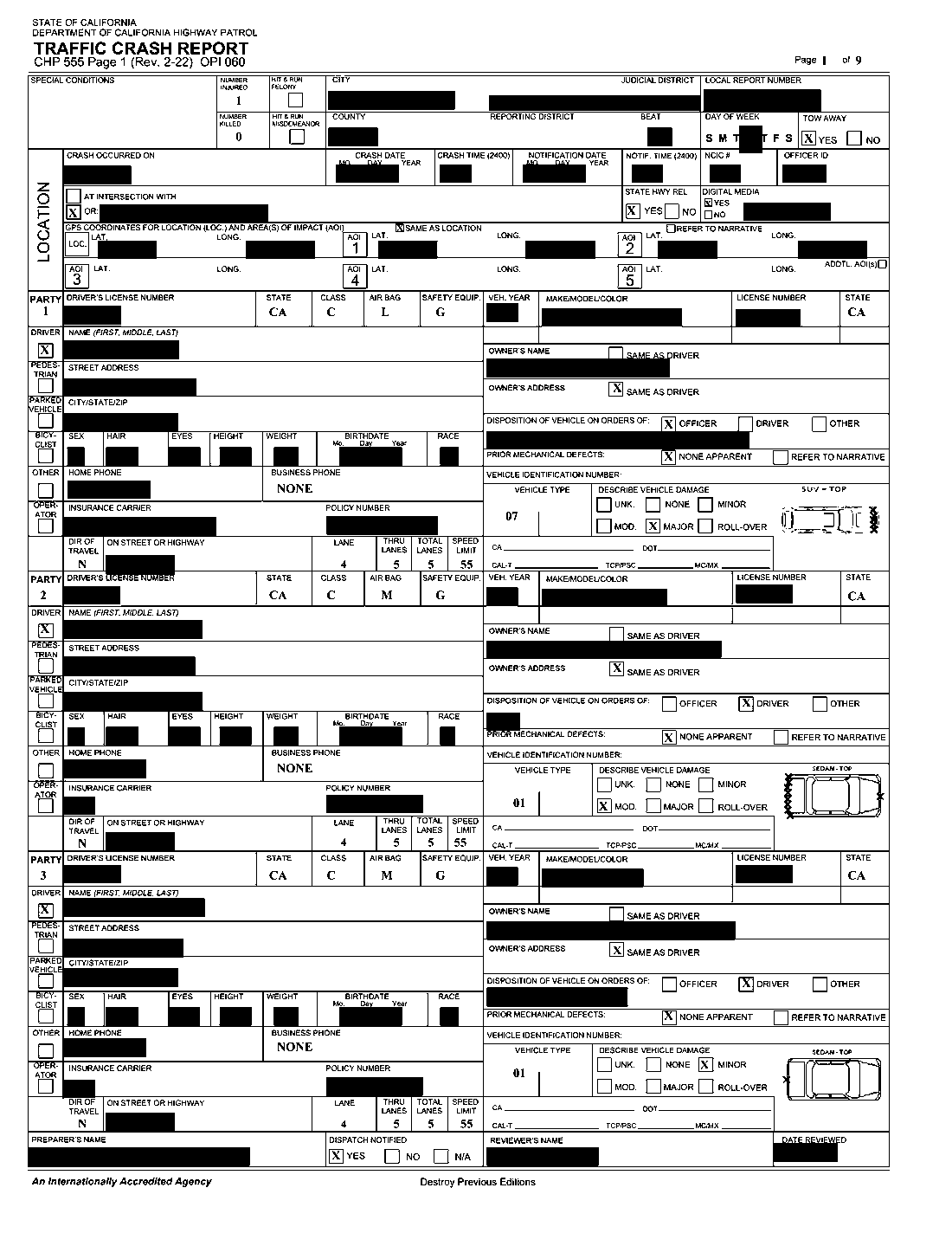
SFPD writes its crash reports in the same format the CHP uses, so reports from both agencies follow the same layout.
Who Can Get a Copy?
Under California law, these people can get a copy of the report:
- Any driver involved in the crash, or the driver’s guardian or conservator
- The parent of a minor driver
- A driver’s authorized representative
- Anyone named in the report as injured
- The owners of vehicles or property damaged in the crash
- Anyone who may be held legally responsible for the crash
- An attorney who states under penalty of perjury that he or she represents one of these people
When an attorney requests a report from SFPD, SFPD asks for a photo of the attorney’s business card showing the State Bar number. SFPD also asks for proof that the attorney represents the injured person, such as a retainer agreement or a letter on law firm letterhead.
How Can a San Francisco Accident Report Help Me?
Soon after a crash, you will likely file a claim with the other driver’s insurance company. The insurance company will likely ask for a copy of the accident report when it decides who was at fault.
The insurance company may rely on the statements in the report when it makes a settlement offer. You can also use the report when you negotiate a settlement. If you cannot reach a settlement, the report is useful in a personal injury lawsuit.
Under California Vehicle Code section 20013, accident reports generally cannot be used as evidence at trial. The report still matters. Its diagrams, descriptions and witness statements help your attorney investigate the crash, prove who was at fault, and find the witnesses who can testify. Your attorney can also use the statements to prepare you for the questions you may be asked under oath.
Request your report as soon as possible, so you have time to look into the important details of your claim.
Talk to a Lawyer Soon After a Crash
A crash can take a physical, emotional and financial toll. Insurance companies start working on a claim soon after a crash. Talking to a lawyer early gives you time to collect evidence and find witnesses while they are still available.
Attorney Wes Wakeford has more than 20 years of experience as a personal injury attorney in the Bay Area.
If you were injured in a crash, contact me or call me at (415) 578-3510 for a free case review.